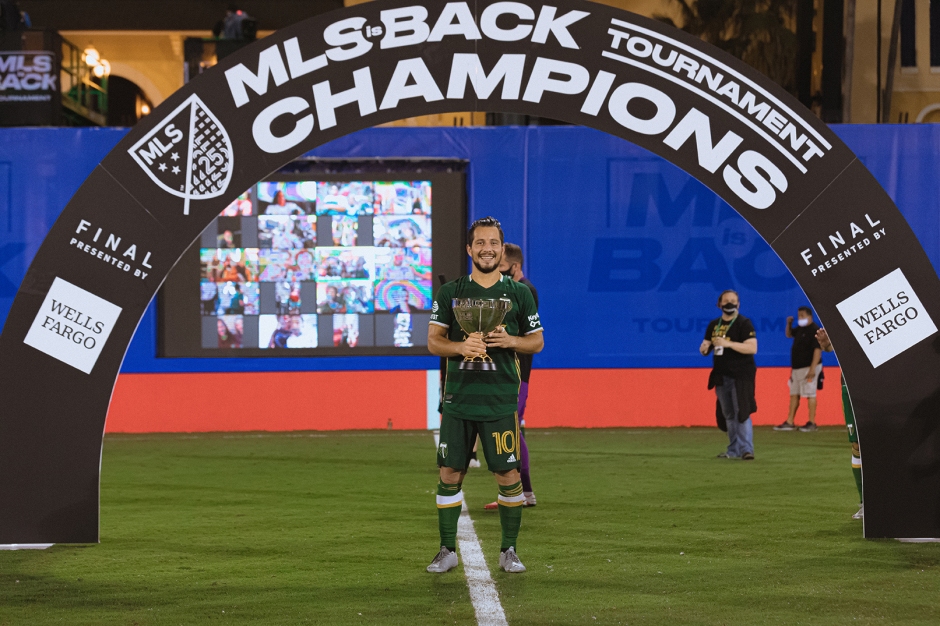
The Portland Timbers lifted the MLS is Back trophy this summer, and as fall approaches it’s time to look back on how the Timbers pulled off this victory.
In this video, I look at how the Timbers outplayed their opponents despite an overwhelming lack of possession.
The main points of focus are how the Timbers set up defensively to stifle the opponent, how they counter attacked, how they played with the ball when the opponent was sitting deep, how they pressed high up the field on occasion, and how they executing four goals off of set pieces in the last two games.
Sebastian Blanco is a main focus of this video, and with the Argentine winger out with an ACL injury, Portland will surely have to change tactics should they want to make a similar run in MLS Cup later this fall.
The Union’s press was at its best against D.C. United, as Philadelphia moved back into first place in the Eastern Conference.
After back-to-back 4-0 drubbings on the road, the Philadelphia Union bounced back into form with a 5-1 win at Audi Field.
The biggest problem recently for Philadelphia was its mercurial nature on the road.
The Union are now 2-1-3 in its last six road matches, conceding four
goals to New York City FC, Real Salt Lake, and the Montreal Impact. For
the most part, the Union were underwhelming in those losses.
The two wins also came with an asterisk, as the Union got to play
D.C. and Orlando for more than 45 minutes against 10 men due to red
cards.
But even before the red card to Junior Moreno in the 40th minute, the
Union were better than D.C., despite missing a penalty kick. (The Union
are now 3 for 7 converting penalties, the worst in MLS and only team to
convert under 50 percent of penalties.)
The Union amassed 16 first half shots against D.C. United, and went into the half with two goals and a man advantage.
Because of the massive adjustments Ben Olsen was forced to make after
the red card and Chris Durkin’s injury, we’ll focus only on the first
40 minutes and how the two sides fared at full strength.
Each team’s formation ended up being vital in dictating how it would play, and where it would try to isolate opponents.
D.C. United lined up with a 3-4-3, while the Union played a 4-4-2 with a diamond midfield.
D.C. had the chance to create overloads in wide areas, whether on the
right side with Leonardo Jara and Paul Arriola vs. Kai Wagner.
Cover would have to come from Warren Creavalle or Aurelien Collin,
and whether it was Colin or Creavalle sliding to help, an opening would
be created.
If Collin steps over, Rooney should easily make a splitting run
between the center backs, and at least draw Jack Elliott out of position
and create a gap in the middle.
If Creavalle steps over, which is what the Union prefers from its wide midfielders, there should be more space in the midfield.
The situation was the same on the left side with Lucas Rodriguez and Lucho Acosta trying to overload Ray Gaddis.
Teams playing against the Union can make the most out of
Philadelphia’s aggressive pressing by playing the ball into wide areas
and forcing Creavalle and Bedoya to shuffle wide to the opposing
wingback. D.C. benefits because either the Union midfielders wear down
quickly, or Haris Medunjanin gets isolated in the midfield.
Unfortunately, D.C. were unable to take advantage of its advantage on the wings.
The other position where D.C. – and even the Union – looked to created space was with the front three attackers.
Rooney, Acosta and Arriola had the additional defensive duties of covering their two-man midfield, and were unable to get behind the Union midfield, and ideally play three versus four against the Union back line.
D.C. struggled to step up from the back, which would have allowed D.C.’s forward three to have more freedom.
United was also unable to clear beyond the Union press and find the forwards in advanced positions and initiate counter attacks.
The
Union, like usual, opted to press D.C. and attempted to force these
clearances through the middle where Medunjanin and company could pick up
the loose ball.
Compared to recent losses, Philadelphia has improved on knowing when
to press: how to hunt in packs, and how to not expose themselves once
the press was beaten.
In previous years, and even certain games this season, Philadelphia pressed haphazardly or individually, and wily opponents took advantage (the opener against Toronto and recent loss to NYCFC are good examples.)
The
key for the press was the Union outnumbering D.C. in the midfield. The
two Union strikers pressed the three D.C. center backs, while Marco
Fabian was free to cover either center midfielders, Moreno or Durkin.
The weak-sided midfielder then tucked in to stick to the other center midfielder. The near-sided midfielder then moved out to rush the outlet to the wing backs of Jara, Rodriguez and Moreno.
The Union forwards pressing the D.C. defense wasn’t revolutionary or necessarily a difficult tactic to counter, however, it did lead to the first Union goal.
Once
D.C. cleared past the pressure and the Union sent the ball back, the
front three for Philadelphia were then able to get enough space for
three-on-three situations.
The biggest issue D.C. had in defending the Union was that the center backs sat off too deep.
Often, the three center defenders would be just yards from their own goal, and invited shots from range. The Union capitalized on the first goal, and a large percentage of the 16 first half shots came from D.C. giving Union players too much room to shoot.
It was really unfortunate that this match had a red card, as Ben Olsen would have had to make adjustments at half time.
D.C. is a much better squad than the scoreline suggested, and the second half could have been a much closer affair.
This short-lived but growing rivalry is always a good match, especially because of how different the two teams want to play.
Atlanta United under Frank de Boer looks for slow build up, looking for the right moment to strike, while the New York Red Bulls want to press the opponent into making a mistake high up the field.
Take a look at the video to see how I break down the match.
In this episode, I break down the 3-2 Union victory over the New York Red Bulls.
The Union set up to try and control the match, and looked strong until a couple of Red Bull counters put the visitors ahead at the half.
Ilsinho came on and made a big impact, but this episode will focus mainly on midfield runs.
Kaku scored the first with a deep run past the Union midfield, and Jamiro Monteiro repaid the favor with one of his own.
I’ll also look at how Ilsinho was able to get by his man and draw defenders away from their positions, which created openings for both his team mates and himself to exploit.
This episode looks at the Philadelphia Union’s 1-1 draw in British Columbia vs. the Vancouver Whitecaps.
I look specifically at how the Union tried to break down a tough Vancouver defense and how Vancouver were able to break through the Union midfield, but couldn’t beat the back line.
In this episode, I break down the goals and big plays from the LA Galaxy’s 2-0 win over the Philadelphia Union.
I focus specifically on the little things Zlatan Ibrahimovic does in and around the box that makes him such a lethal striker. I also look at how the Galaxy were able to bypass the Union’s four-man midfield, and then play in front of the Union defense.
In this video, I breakdown the goals and big moments from the Philadelphia Union’s 2-1 win over FC Dallas.
I focus specifically on the impact made by the three Union substitutes – Cory Burke, Jamiro Monteiro and Ilsinho – and how their inclusion gave Philadelphia more dimensions on attack.